Are you struggling with toenail pain?
Ingrown or Involved Toenails?
What is an ingrown toenail?
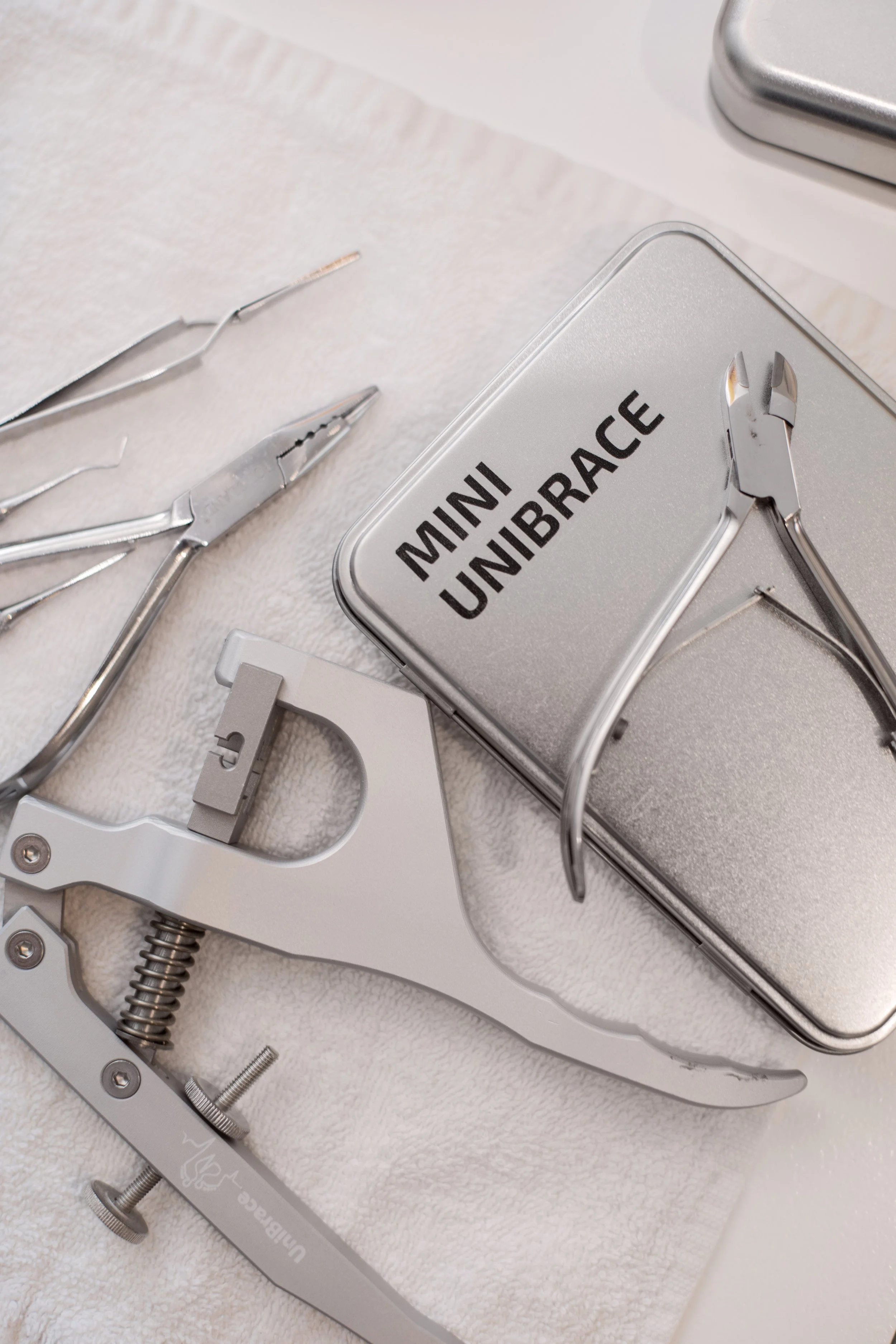
A common but very uncomfortable condition, ingrown toenails occur when the nail penetrates where the skin meets the nail fold. This can be painful and lead to infection, as well as causing the nearby skin to re-grow over the nail, exacerbating the issue. If an infected ingrown toenail isn’t treated then walking and movement can be difficult, and your quality of life can be impacted. UniBrace is the newest technology used to treat ingrown and involuted toenails using a nail brace that reshapes the nail and ensures natural nail growth.
A Podologist will create and adapt an individualized system that treats your ingrown or involuted (pincer) nail. The UniBrace system is allowing the nail to reshape and naturally grow out. The entire process is pain-free, from start to finish.
How does it work?
UniBrace is a revolutionary nail correction system, which helps ingrown or involuted toenails grow back to their natural shape without the need for surgery or any pain.
UniBrace uses a surgical wire and composite material which is cured by a LED light and acts like a brace on the nail plate. This ensures that the nail remains in the correct shape as it grows from the base of the nail until the end, thus reshaping the pathway for the new nail growth.
UniBrace system is applied to your toenail for about 1 month. When the toenail grows, the brace will grow with the toenail and helps the toenail grow in the correct position.
We recommend 1 – 6 months of treatment, with monthly appointment intervals. Once complete, the brace is removed, and the nail continues to grow naturally.
The process.
Before applying UniBrace we will file and smooth your toenail for application. All nail folds will be cleared of nail debris and the entire nail plate cleaned.
How long does it take?
An appointment lasts 30 minutes.
Before your appointment:
Remove all nail polish, gel polish and artificial nails.
Precautions:
UniBrace is not recommended if the nail is detached from the nail bed, or if presence of infection involving more than 50% of the total nail area is present.
After your appointment:
For optimal results it’s important to follow the below instructions as closely as possible:
Avoid swimming or bathtubs for 24 hours.
Avoid wearing tight fitting or narrow shoes.
Nail polish can still be applied however patients cannot use shellac or other acrylic toenails.
Frequently asked questions:
Can I return to normal activities after UniBrace application?
Yes, you can go back to work, wear enclosed shoes. We however recommend patients not to swim in the first 24 hours following application and avoid any tight-fitting shoes.
Do I need to get local anesthetic for UniBrace application?
No, you don’t require local anesthetic for application.
How long will I need the nail brace on my toe for?
A continuous bracing period of 1-6 months is required in most cases.
Can I wear shoes as usual with toenail bracing?
Yes. Although, there’s an increased chance of the brace coming loose if worn with shoes that are too tight or narrow at the toe box. For example, in pointed stilettoes the bracing may be less effective.
Does the nail brace hurt?
It’s painless to apply, but you may experience some discomfort from the tension of the brace after initial application and follow up adjustments. This mild discomfort usually subsides within 24-48 hours.
When can I get back to work or sport?
Immediately. However, bracing is not recommended for those that participate in sports that require kicking or tight-fitting boots/shoes.
Can I still paint my toenails?
Yes, you can paint over the brace if desired without affecting the brace.
Signs of an ingrown toenail:
Pain, tenderness, unusual warmth or throbbing on either side of the nail. Inflammation and redness with swelling on either side of the nail. Pain when putting pressure on the nail. Bleeding, pus or fluid coming from the affected area. Pain when walking or wearing shoes. Pain or discomfort from the weight of a blanket or sheet.
What to do for an ingrown toenail?
If you have some or all of the symptoms listed above and are wondering how to treat ingrown toenails, you will probably require treatment. Depending on how early you identify the issue, your treatment options will vary. If you need to treat an ingrown toenail, give us a call.
The most common cause of ingrown toenails is cutting your nails too short or at an improper angle. You might also be prone to ingrown toenails due to your genetic background or if you injure your toe or the nail.
When should I seek treatment for an ingrown toenail?
In some cases, you can treat an ingrown toenail in the early stages at home by soaking your foot in warm water before trimming and filing your nails.
However, if you have signs of an infection or you’re unable to properly trim your nails on your own, you should schedule an appointment. Infected toenails can cause symptoms in the affected toe like:
• Pain
• Redness
• Swelling
• Warm to the touche
The benefits of UniBrace:
Pain-free treatment
Rapid pain alleviation
Corrects the nail through natural nail growth
Effective without exerting force on the nail
Treatment is customized to each individual case
Effectiveness confirmed by clinical study
Particularly suitable for those with diabetes
No restrictions on patient activities (incl. swimming/sauna)
Nail polish can still be used
Does nail brace work?
Nail bracing for ingrown or over-curved toenails is very effective when applied correctly and for the right nail condition. However, there are some ingrown toenail conditions where nail surgery would be more effective.
Why nail bracing instead of ingrown toenail surgery?
Bracing is a more conservative option that is great for kids or anyone who is anxious about toenail surgery. Bracing is also more suitable for those with some medical conditions such as peripheral vascular disease.
Although we do our very best to select the right toenail condition that would benefit from bracing, in some rare cases, nail bracing may not achieve the desired outcome. Toenail surgery may be suggested should the ingrown toenail condition not fully resolve or return following a treatment period of bracing.
We will discuss all factors that improve the outcome of toenail bracing and help prevent reoccurring once the brace is removed.
Nail bracing is not recommended if you.
Play kicking sports such as soccer, football.
Want to wear pointed high heels or tight-fitting shoes during treatment.
Have a fungal infection that is affecting the strength or integrity of the nail edge.